The 8-layer structure of the skin — why the same treatment can produce different results | Obliv Seoul Origin
Registration Date
Blog summary
The reason the same procedure can produce different results lies in the skin’s eight-layer structure. The effectiveness depends on which layer you target, from the epidermis down to the bone layer. Summarized from an O'Blive skin architecture perspective. 5 minutes from Jonggak Station.
Blog table of contents
These days, there are so many skin treatment options. Even when people talk about the same concern, one clinic may recommend a laser, another an injection, and another a lifting procedure. Yet strangely, some people get different results even after receiving the same treatment. This isn’t just because of the device, and it isn’t just luck.
Did you know that skin isn’t a single sheet of paper but is made up of multiple layers? Depending on which "layer" your skin concern starts in, the treatment it needs can be completely different. Once you start looking from the perspective of the 8 layers of skin, it becomes clear why some treatments work and others don’t.
The 8 Layers of Skin, from the Epidermis to the Bone Layer
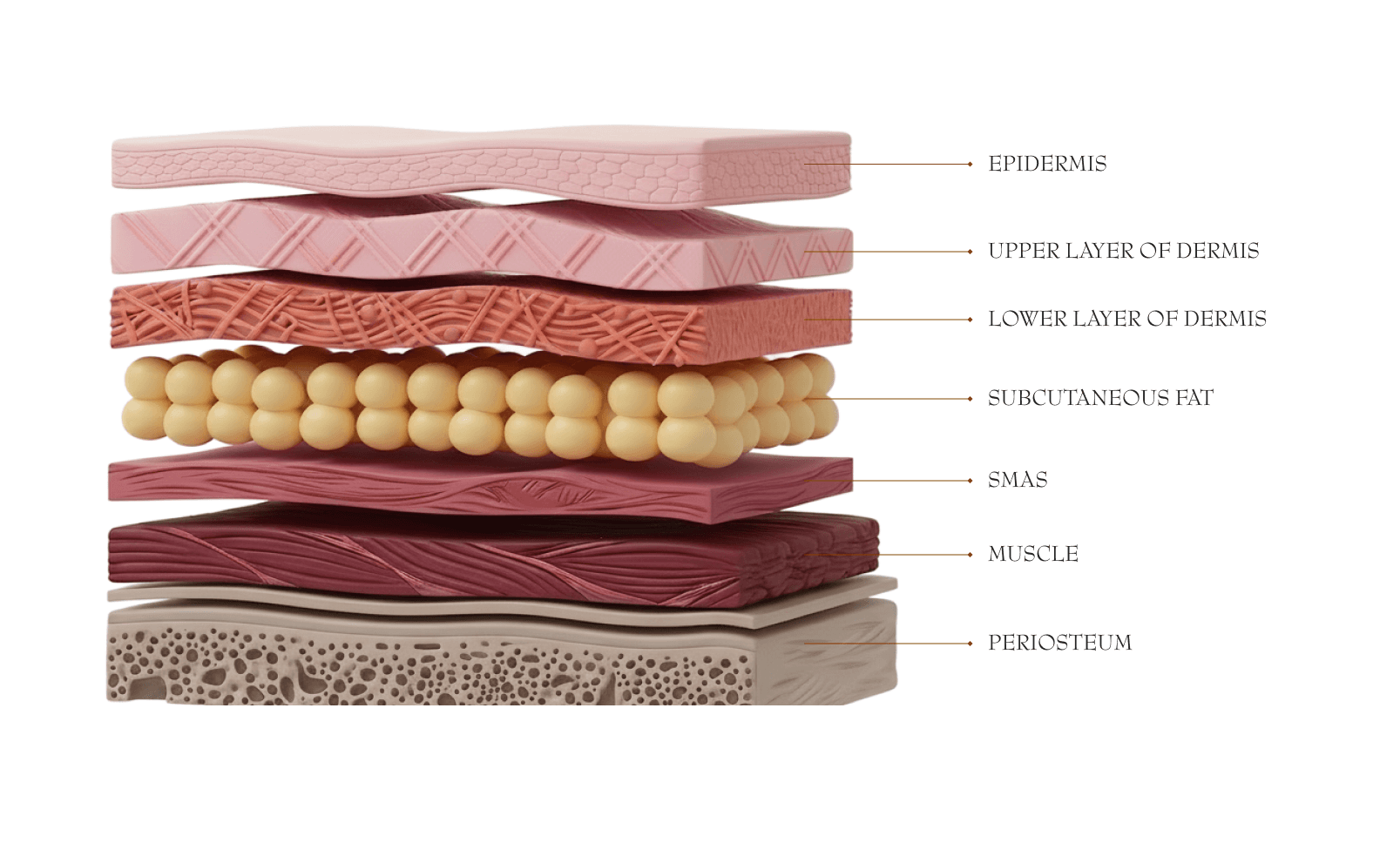
Skin is not a thin covering that you can touch with your hand. From top to bottom, it is stacked in eight layers: the epidermis, upper dermis, full dermis, lower dermis, subcutaneous fat layer, fascia layer, muscle layer, and bone layer. Each layer has a different role and is made up of different tissue.
To compare it with a building, the outer paint is the epidermis, the bricks underneath are the dermis, the steel and concrete are the subcutaneous fat and fascia, and the innermost pillars are the muscles and bones. Repainting only the outer wall of a building won’t make the pillars stronger. On the other hand, if the pillars are shaking and you only paint over them, cracks will soon appear again.
Skin treatments are the same.
• Epidermal layer — pigmentation, skin texture, barrier function
• Upper dermis — fine lines, moisture, smoothness
• Mid and lower dermis — elasticity, collagen, deep wrinkles
• Subcutaneous fat layer — volume, facial contour
• Fascia layer — lifting, the true starting point of sagging
• Muscle layer — expression lines
• Bone layer — overall facial structure
Even the same 'wrinkle' starts in different layers
Among skin concerns, the word that causes the most misunderstanding is "wrinkle." The single word includes completely different types. Wrinkles around the eyes that appear only when you smile, lines that drape below the cheekbones, fine wrinkles that thinly cover the skin’s surface, and sagging-type wrinkles that settle along the jawline. Outwardly, they are all 'wrinkles,' but they start in different layers.
Expression wrinkles start in the muscle layer. As you repeatedly make facial expressions, marks remain where the muscles move. That is why expression wrinkles are relieved by controlling muscle movement.
Volume wrinkles are a problem of the subcutaneous fat layer. As we age, if subcutaneous fat decreases or shifts, the skin above it sinks and begins to look wrinkled. In this case, an approach that restores or redistributes volume is needed.
Texture wrinkles and fine lines occur as collagen and moisture in the upper dermis decrease. Treatments that refill this layer are effective.
Sagging-type wrinkles begin in the deepest place, namely the fascia layer or the lower dermis. It is a state in which the skin’s "pillars" are shaking, something you cannot fix by touching only the upper skin.
Why is this distinction important? For example, if you repeatedly use a treatment for superficial fine wrinkles on sagging-type wrinkles, the effect is only temporary and the root cause remains. Conversely, if you use a strong lifting treatment for fine wrinkles, it can become overtreatment and the result may look unnatural.
So when choosing a procedure, the first question is not "Which treatment should I get?" but "Which layer does this treatment reach?"
This is how you tell which layer your concern started in
So is there a rough way to gauge it for yourself? An accurate diagnosis is the doctor’s domain, but a general direction can be summarized as follows.
Upper to lower dermis — texture, moisture, fine lines, elasticity concerns
If makeup doesn’t sit well, pores stand out, and your skin tone looks uneven, you may suspect the upper to lower dermis. Olive Injection is a treatment that acts on this layer. It targets the upper to lower dermis while reorganizing the skin’s texture and moisture environment. Why it’s grouped under the same "skin booster" umbrella even though the approach is different will be covered in a separate article.
Lower dermis and fascia layer — elasticity and sagging concerns
Has your jawline become less defined than before, and do you look much better when your face is lifted upward? If so, the starting point of the problem is likely the lower dermis or the fascia layer. Radiofrequency lifting that precisely delivers heat down to this depth is where Alltite comes in. There are many lifting devices, but the difference ultimately comes down to how accurately the heat is delivered to the right layer and how much of it reaches there.
Subcutaneous fat layer — volume and contour concerns
If the fat under your chin bothers you, or if you want to refine your contours because your face looks puffy, the subcutaneous fat layer should be the target. Ollidia is an injectable treatment that acts on this layer. The reason it can’t be summarized in one line is that even with the same drug, results change completely depending on which area and how deep it is injected.
Shallow dermis around the eyes and under-eye area — dark circles and fine under-eye lines
The skin under the eyes is much thinner than other parts of the face, and the dermis layer is also shallow. So if you apply treatments used on the cheeks as they are, nodules or visible marks can easily remain. That is why an eye-specific approach is needed. Rejuran I is a treatment that delicately works on this thin dermal layer.
To use an analogy, if the roof is leaking but you only replace the wallpaper, the wall keeps getting wet. On the other hand, if the wallpaper is peeling thinly and you repair the roof, the cost is excessive while the problem remains. In the end, finding the layer where the problem begins and choosing the treatment that reaches that layer precisely — that is the first principle of treatment selection.
The eye for which 'layer' you're looking at ultimately determines the result
This is why the same device and the same drug can produce different results from one clinic to another. If, at the diagnosis stage, you fail to identify exactly "which layer this person’s concern started in," even the best equipment will end up working in the wrong place.
At Obliv, this perspective is organized under the name 'skin architecture'. The skin is viewed as a 'structural architecture' made up of 8 layers, and before treatment the patient’s skin is analyzed three-dimensionally by layer to identify the root layer of the problem. The amount injected into the same injection differs from person to person, and for the same radiofrequency device, the amount of energy and the depth at which it should be delivered also differ.
Even with the same device, which layer it reaches determines the result.
Skin architecture is not simply about "looking carefully." It means systematizing diagnosis and treatment planning based on layer-by-layer anatomical structure, rather than on the practitioner’s subjective intuition.
Frequently Asked Questions
Q1. Are skin layers really divided into 8?
In medical textbooks, the skin is classified into three basic layers: epidermis, dermis, and subcutaneous tissue. But from a treatment perspective, it is viewed in much finer detail. If the dermis is divided into upper, middle, and lower layers and the fascia, muscle, and bone layers below that are also separated, for a total of eight layers, treatment depth can be planned far more precisely. This is exactly the perspective of Oblive’s "skin architecture."
Q2. Can I judge for myself which layer my skin concern belongs to?
You can get a rough sense of the direction. Texture and tone concerns are generally in the upper dermis, elasticity and sagging in the lower dermis to fascia layer, and volume concerns in the subcutaneous fat layer. However, because many concerns involve multiple layers, an accurate diagnosis requires the doctor’s layer-by-layer analysis.
Q3. Can one treatment solve multiple layers at the same time?
Some treatments act across multiple layers, but there is no "all-purpose treatment" that produces optimal results for every layer at once. In fact, combining treatments by layer often leads to more natural and more satisfying results.
Closing — In the end, treatment is a matter of 'which layer does it reach?'
Skin is not one layer but eight. So even if it is the same wrinkle, the same sagging, or the same tone concern, the answer is different if the starting layer is different. When choosing a treatment, the question just as important as "What should I get?" is "Which layer does this treatment reach?" There are times when you need a doctor’s eye that reads the skin by layer in order to give an accurate answer to that question. If you are considering treatment, we hope you find a clinic that asks first not for the device name, but "Which layer of my skin is sending the signal?" We hope you get a satisfying answer from the layer where your concern began.
Previous Post
Next post
There is no next post.
Recommended Articles
We’re preparing better content. Please wait a moment.